Our Location
5th Floor, Huake Center, Lanshan District, Linyi City, Shandong Province, China

5th Floor, Huake Center, Lanshan District, Linyi City, Shandong Province, China
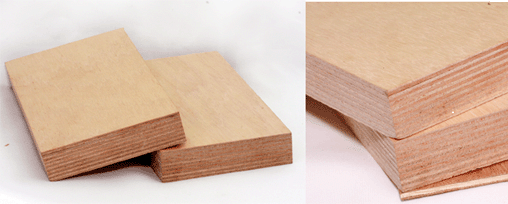
Plywood under carpet is a common base for homes that want a smooth, solid feel underfoot without the cost of a hardwood subfloor. The plywood smooths the joists, spreads the load, and gives the carpet something flat to sit on, so the pad and the pile stay even across the room instead of telegraphing every board beneath them.
Getting carpet over plywood right comes down to the panel grade, the joints, and the moisture control, because a soft or squeaky base shows through the carpet no matter how good the carpet itself is. The preparation, not the carpet, decides how the floor feels underfoot.
Yes. Plywood is one of the most common subfloors under carpet, and carpet installers work over it every day. The key is that the plywood must be flat, dry, and firmly fastened before the pad and carpet go down.
The main risk is not the plywood itself but the gaps and the movement. A subfloor that flexes or squeaks works the carpet loose over time, and a panel that has swollen at the edges leaves ridges that show through even a thick pad.
Plywood also holds tack strip and staples well, which is why it suits a stretched-in carpet. The installer staples the pad and anchors the tack strip to the plywood, so a sound panel keeps the whole installation tight.
Particleboard and OSB also appear under carpet, but plywood holds staples and resists moisture better than particleboard, which crumbles when it gets wet. Plywood’s cross-lamination keeps it flatter across the joists, so the finished floor feels solid rather than springy.
That flatness matters most on older homes where the joists have settled. A plywood layer bridges the low spots and levels the floor, which the carpet then reads as a smooth, even plane.
Every bump, dip, and squeak in the plywood telegraphs through the carpet. The pad hides small faults, but a lifted joint or a loose panel turns into a visible ridge or a soft spot that the homeowner feels with every step.
Prep also protects the carpet’s life. A flat, tight subfloor stops the backing from rubbing, keeps the seams from working, and stops the fasteners from pulling, so the carpet stays smooth for years instead of months.
Moisture is the other half of prep. A damp subfloor traps water under the carpet, which grows mould, delaminates the panel, and stains the backing. Checking and controlling moisture before installation prevents the problem the carpet would otherwise hide.
Lay a long straightedge across the floor and look for the gap beneath it. Small dips fill with patching compound, while high spots get sanded or planed down. The floor should meet the installer’s flatness tolerance before the pad arrives on site.
Fix the movement first, then the flatness. A floor that still flexes sends the carpet loose no matter how level it looks, so soundness comes before cosmetics in the prep order.
Prep starts with the fasteners. Drive every screw and nail below the surface, then fill the dimples with a floor patch so nothing pokes up into the pad. A single proud fastener becomes a lump under the carpet within days.
Next, deal with the joints. Fill gaps and seams with a patching compound, and sand the ridges flush so the panel lines do not print through. Wide gaps at a panel edge let the carpet dip into the gap, so they need filling, not ignoring.
Sweep and vacuum the surface until it is free of dust, grit, and old staples. Any debris trapped under the pad grinds against the carpet backing and grinds against the backing every time someone walks on it.
Use a floor patching compound for gaps under about 6 mm, and fill larger gaps with a strip of plywood or a wood filler that takes a fastener. Fill the seams across the whole floor so the carpet reads one continuous surface, not a grid.
Let every patch cure fully before the pad goes down. A wet patch under carpet traps moisture and softens, and the soft patch becomes the very lump the prep was meant to remove.
The underlayment sets the feel and the moisture path. A carpet pad cushions the pile and extends the carpet’s life, while a moisture barrier stops vapour from reaching the carpet from below when the subfloor sits over a crawl space or a slab.
Choose the pad by the traffic and the carpet. A denser pad supports heavy traffic better, and a thin, firm pad suits a loop pile, while a thick, soft pad flatters a plush carpet but can buckle a light one at the seams.
On a concrete slab, test for moisture and add a barrier where the reading is high. Over a vented crawl space, a vapour barrier under the subfloor keeps the plywood dry and stops the seasonal swelling that lifts the joints.
The pad thickness pairs with the carpet backing, and the wrong pairing shortens the carpet’s life. Ask the carpet maker for the pad range, then match it, because a pad outside the range voids many warranties.
A pad with a moisture barrier suits a slab, while a standard pad suits a dry, sealed subfloor over a heated space. The choice follows the site, not the carpet alone.
Install the tack strip around the perimeter, leaving a small gap at the wall, then roll out the pad and staple it to the plywood without compressing it. Keep the staples away from the carpet’s stretch zone so they do not pull through the pad later.
Stretch the carpet onto the tack strip with a power stretcher rather than a knee kicker, which distributes the tension evenly and stops the carpet from relaxing into a wrinkle. A proper stretch is what keeps the carpet tight over the years.
Finish at the edges and the transitions so the carpet meets doorways, tiles, and thresholds cleanly. A tidy transition protects the carpet edge and stops the backing from fraying where the floor changes material.
If the floor squeaks, find the source before the carpet hides it. Screw the plywood to the joists and add blocking where a panel spans between them, because a squeak under carpet is far harder to fix once the floor is covered.
Walk the whole floor after fastening and listen. Catching the movement at the prep stage costs minutes, while catching it after the carpet is laid costs the whole installation.
The first mistake is skipping flatness. A floor that looks fine from standing height can hide a dip that shows through the carpet once the pad and pile settle. Check with a straightedge, not with an eye.
The second mistake is ignoring moisture. Laying carpet over a damp subfloor traps the water and grows mould, so always test the moisture and add a barrier where the reading is high, especially over a slab or a crawl space.
The third mistake is using the wrong pad. A pad that is too thick or too soft lets the carpet buckle and the seams open, so match the pad to the carpet and the traffic the room will actually see.
If a lump appears after installation, the carpet may lift at a seam or the pad may have shifted. A stretched carpet can sometimes be re-stretched, but a subfloor fault usually needs the carpet pulled back and the base repaired.
Prevention is cheaper than the repair. Flat, dry, and tight plywood under the carpet avoids nearly every complaint that would otherwise bring the installer back.
The subfloor panel should be flat, stable, and suited to the site. Commercial Plywood gives a flat, screw-holding base for a staple-down carpet, while Film Faced Plywood suits a moisture-prone area where a sealed face helps. Melamine Plywood and MDF Board cover smooth underlayment tiers where a uniform surface matters, and Chip Board fills the budget end of the range for dry, light-duty rooms.
Suppliers such as HYY list the thickness and the bond class on the contract, so the buyer can order a panel that stays flat under the pad and dry beneath the carpet.
Can carpet be laid directly on plywood? Yes, with a pad over the plywood. The plywood must be flat, dry, and firmly fastened, and the pad matched to the carpet.
Do you need underlayment over plywood for carpet? A carpet pad is standard over plywood, and a moisture barrier is added where the subfloor is damp or sits over a slab.
What thickness of plywood is best under carpet? A structural panel thick enough to span the joists stays flat, and the joint spacing sets the exact thickness for the room.
How do you stop plywood from squeaking under carpet? Screw the panels to the joists, add blocking between them, and fix any movement before the pad goes down.
What grade of plywood goes under carpet? A sound, exterior-bonded panel is the safe choice where moisture is a risk, and a flat commercial panel suits dry interior rooms.