Our Location
5th Floor, Huake Center, Lanshan District, Linyi City, Shandong Province, China

5th Floor, Huake Center, Lanshan District, Linyi City, Shandong Province, China
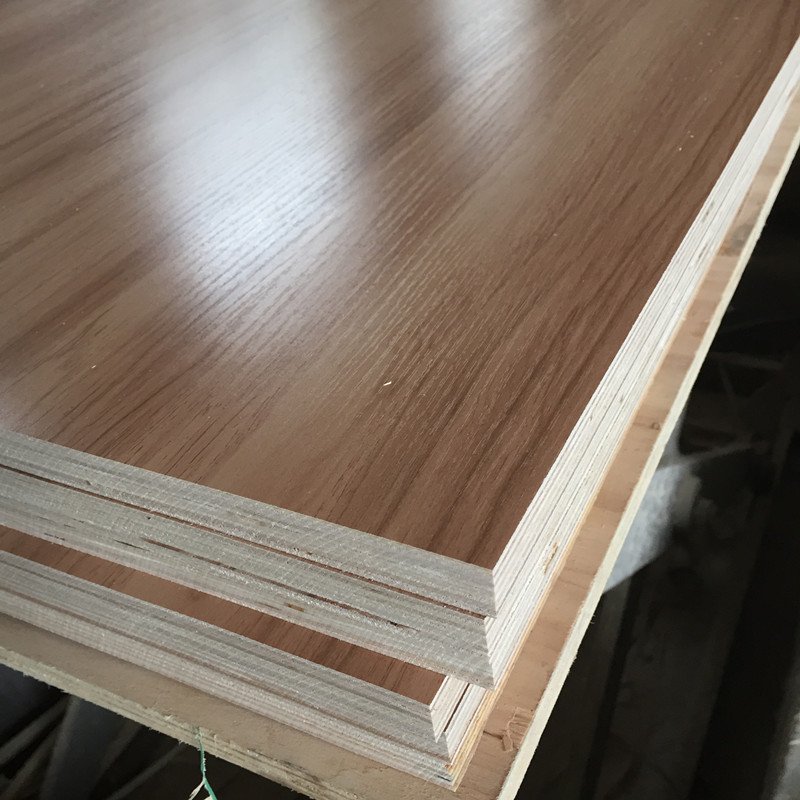
When a furniture maker compares plywood vs melamine, the real question is which surface and core will hold up through years of daily use and hundreds of cut parts. This guide compares core stability, moisture resistance, finish options, hardware holding, and cost, then gives you a decision path for cabinet boxes, wardrobe panels, shelving, and production-line buying.
Neither panel wins every job. Plywood builds strength into the core, while melamine delivers a finished face straight off the pressing line. The right choice depends on your production method and the environment the furniture lives in.
Plywood starts as a cross-laminated sheet of thin veneers peeled from logs and bonded under heat, with each layer running its grain at right angles to the layer below. That construction gives the core stiffness in both directions, strong screw holding, and predictable behavior under changing humidity.
Melamine, in everyday panel language, is the plastic-resin face pressed onto a wood core. Producers impregnate decorative paper with melamine resin, then laminate it onto a substrate such as particle board, MDF, or plywood. What customers call a melamine board, therefore, is really a surface system sitting on a core, and the core decides most of the structural behavior.
Buyers see two products under the same name. A melamine-faced plywood panel carries the resin face over a veneer core, which keeps the structural advantages of plywood and adds a clean, low-maintenance surface. A melamine board usually means the resin face on a substrate such as MDF or particle board, which cuts cost at the expense of screw holding and edge strength.
For cabinet work, the core matters more than the face. Plywood cores resist screw pull-out and handle hinge cycles well, while particle-board cores grip screws lightly and strip sooner after repeated hardware changes. For that reason, specifiers decide between the products based on the joint and hardware design, not just the surface appearance.
Many catalogs blur the line by offering melamine-faced plywood, which answers the finish question without losing the core reserve. That middle option suits workshops that want factory faces but keep the structural strength of veneer for shelves and face frames. Specifying it costs more than a particle-board melamine panel and far less than reworking failed edges later in production.
The comparison table below sorts the options by the decisions a workshop actually makes. Keep it next to the order form when you specify panels.
| Property | Melamine-faced board | Veneer plywood |
|---|---|---|
| Surface durability | Resists scratches and stains with no coating | Needs paint, lacquer, or veneer finish |
| Moisture at cut edges | Cores swell when edges stay wet | Veneer edges resist swelling better |
| Hardware holding | Strong on MDF, weaker on particle board | Strong in face and edge |
| Finish options | Factory colors and patterns only | Field coating or factory lacquer |
| Weight | Depends on core weight | Heavier and stiffer |
| Piece price | Lower on simple sizes | Higher, with better resale value |
The melamine face resists scratches and fingerprints without any finishing line, which speeds production. However, every cut breaks the resin seal, and an unsealed edge on a particle-board core draws water. Veneer plywood avoids that trap because the cut edge still exposes layered wood that sheds moisture better.
For painted furniture, both panels accept finishing, but plywood paints without a priming issue on the edge. For color-matched production, the factory melamine face wins on consistency. Consequently, the specification usually follows the finish strategy before any price comparison starts.
Melamine surfaces shine in high-volume, dry-interior production where consistency and speed outrank structural reserve. Retail wardrobes, flat-pack shelving, and kitchen cabinet interiors fit this profile.
First, match the substrate to the hardware. A hinge block with repeated screw changes strips out of particle board quickly, so choose an MDF Board core for parts that carry hinges. Next, plan all cutting with the laminated face on the same side every time, so the visible edge stays consistent across the batch.
The melamine surface hides a range of cores, and price follows the core. MDF cores cut cleanly and hold screws better than particle board, while particle board prices lowest for internal shelves. A buyer who locks the core specification with the order avoids surprises where a low sheet price meets a heavy hardware requirement.
Veneer plywood carries structural jobs that a resin face cannot save. Built-in units, face frames, load-bearing shelving, and any furniture near moisture choose plywood for the core and the edge.
Built-in wardrobes and kitchen islands anchor to walls and carry daily loads, so a stiff core matters. Commercial Plywood covers that structural slot with good screw holding and paintable surfaces for interior fit-out work.
Forced hinge changes happen in real kitchens, and a plywood edge absorbs that repeated screw movement better than any resin-faced substrate. As a result, most joiners prefer veneer panels wherever hardware cycles and edge exposure appear together.
Workshops evaluate panels by the second time they cut and assemble them, not the first. This section covers the behaviors that show up after the order lands.
Melamine panels survive spills only while the face stays intact. A scratch through the resin lets moisture reach the core, and particle-board cores swell visibly around the damage. Veneer plywood resists the same water longer, which is why panels near plumbing and outdoor furniture favor plywood construction.
Screws in MDF strip after a few cycles, screws in particle board strip faster, and screws in plywood hold again when repositioned. Hinge installation follows the same ranking, so production lines that rework frequently count the hardware cycle as a material cost, not a labor detail.
A scoring blade delivers clean melamine cuts, while a standard blade chips the face. Veneer panels route and sand without that constraint, so workshops with mixed machinery often standardize on plywood to keep one tool setup. Touch-up stays simpler on plywood too, because a sanded patch blends into the surrounding surface.
On arrival, check the face for contact marks and every panel for flatness, because a bowed melamine sheet never lies flat in a cabinet line. Store panels flat in small bundles so the resin face does not scuff between sheets, and cut before the parts sit too long under humid shop air.
Score the order against these questions, and the panel choice becomes a specification instead of a debate.
If moisture, hardware, or load decides the answer, choose veneer plywood. If color consistency and production speed drive the call, a melamine-faced panel works well. For budget interiors with light loads, a particle-board-based melamine panel such as this Chip Board fills the shelf market, and Melamine Plywood bridges the two worlds on a veneer core.
Before the container loads, lock the core, the face coat, the edging plan, and the size tolerance in writing, the way HYY specifies every furniture panel export. Verify a sample panel for color and screw behavior, then hold the supplier to the agreed spec.
Which is better for kitchen cabinets, plywood or melamine? For cabinets near moisture or with heavy hinge loads, plywood wins; for dry interiors with factory color finishes, melamine works at lower cost.
Does melamine-faced plywood exist? Yes, a melamine resin face on a veneer core gives factory finish with plywood edge and screw performance.
Will melamine panels scratch in daily use? The face resists scratching well, but deep scratches that reach the core invite moisture damage on particle-board cores.
Can I paint over melamine panels? Painting over the resin face needs thorough sanding and primer, so most shops buy plywood surfaces when field finishing matters.
How do I confirm the core before ordering? Ask for the substrate type, density, moisture content, and face weight on the data sheet, then test a sample for screw holding.
Which panel survives repeated moving and rework? Plywood keeps its screw grip through multiple hardware cycles and re-assembly, while resin-faced particle boards strip faster each time.